Scientific machine learning · 2017
Physics Informed Deep Learning (Part I): Data-driven Solutions of Nonlinear Partial Differential Equations
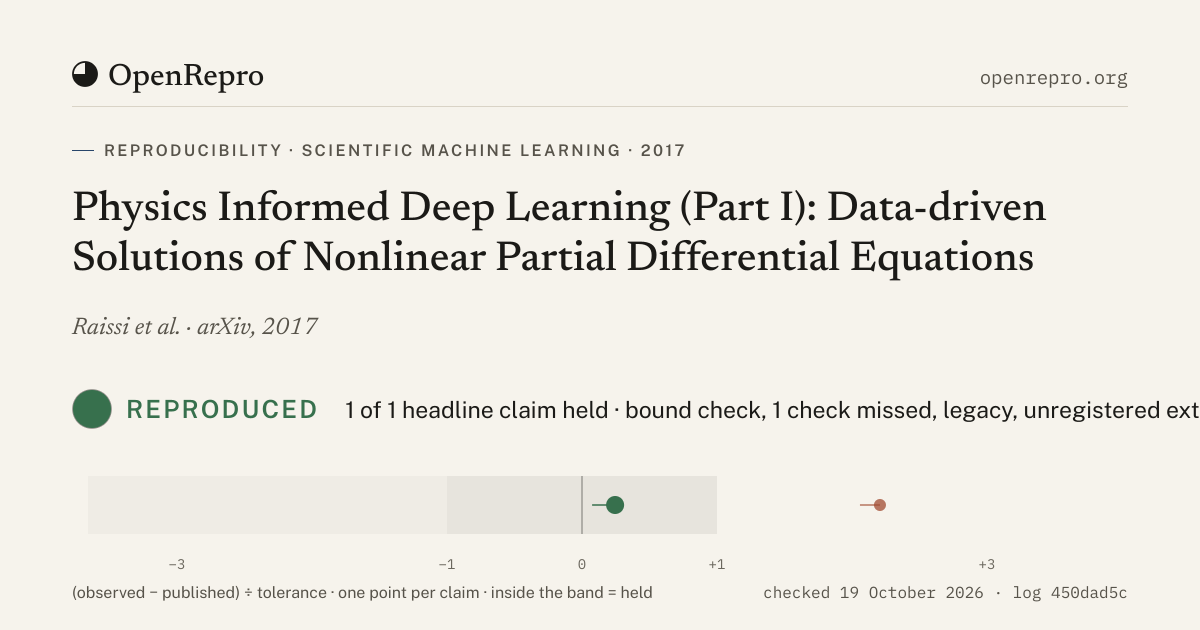
Does PINNs (Raissi et al., 2017) reproduce? Yes, within a broad bound: when OpenRepro re-ran the authors' code, 1 of 1 headline claim held within tolerances registered before results were recorded; Burgers error 3.21× the published value; passes a registered 10× ceiling; a stricter 2× check did not hold; legacy attempt: the plan was never sealed; claims were frozen only by their first result; at least one value was read from an excerpt the agent chose after seeing the output, not by a rule fixed before it (checked 19 Oct 2026).
Does “PINNs” reproduce?
Yes, within a broad bound. 1 of 1 headline claim held within tolerances registered before results were recorded; Burgers error 3.21× the published value; passes a registered 10× ceiling; a stricter 2× check did not hold; legacy attempt: the plan was never sealed; claims were frozen only by their first result; at least one value was read from an excerpt the agent chose after seeing the output, not by a rule fixed before it.
- Held (large: headline claim; small: other claim)
- Did not hold
Reading the marks
- Tail: a one-sided claim (at most, at least); the tail points to the open side, which is shaded faintly
The data behind this chart
| Claim | Published | Observed | Accepted if | Deviation ÷ tolerance | Result |
|---|---|---|---|---|---|
| A physics-informed network (9 layers x 20 neurons, N_u = 100, N_f = 10,000) solves the Burgers equation with relative L2 error of order 1e-4 (reported 6.7e-4). (headline) | 0.00067 | 0.00214873 | at most 0.0067 | +0.25 | Held |
| The Burgers relative L2 error is within a factor of 2 of the reported 6.7e-4. | 0.00067 | 0.00214873 | at most 0.00134 | +2.21 | Did not hold |
What the attempt found
Running the authors Burgers.py (the earliest version in their repository, from five months after arXiv v1) with its fixed seeds on CPU gives a relative L2 error of 2.15e-3 for the continuous-time Burgers example, against 6.7e-4 reported. That meets the pre-registered order-of-magnitude headline check (at most 6.7e-3) but not the stricter within-a-factor-of-2 check. The paper own Table 1 shows errors varying between 1e-4 and 1e-2 across neighbouring settings, and this run used a CPU rather than the reported GPU. The Table 1 sweep was not run.
Assurance
- Level
- Legacy (what the levels mean)
- Plan
- Not sealed (legacy): claims were registered before results were recorded, which does not show that no output had been seen
- Evidence
- Legacy matching: each observed value was matched against the text of the logged output it cites
- Execution manifest
- No: not recorded for every cited run, or incomplete (no Git checkout, a driver file that could not be hashed)
- Report re-derived from the log
- Passed: the engine re-derived the report from the log
- Engine version
- 0.2.1
- Predates
- plan seal, evidence binding, execution manifest, paper text hash, scored job flag, retry reasons, extraction rule
- Qualifiers
- Burgers error 3.21× the published value; passes a registered 10× ceiling; a stricter 2× check did not hold; legacy attempt: the plan was never sealed; claims were frozen only by their first result; at least one value was read from an excerpt the agent chose after seeing the output, not by a rule fixed before it
Headline claims
| Claim | Published | Observed | Accepted if | Result |
|---|---|---|---|---|
| A physics-informed network (9 layers x 20 neurons, N_u = 100, N_f = 10,000) solves the Burgers equation with relative L2 error of order 1e-4 (reported 6.7e-4).¶Section 3.1, Fig. 1 caption, p. 8 · registered at event 8 · quote verified on p. 8 · broad bound, observed 3.21× the published value | 0.00067relative L2 | 0.00214873 | at most 0.0067 | Held |
Other claims checked
| Claim | Published | Observed | Accepted if | Result |
|---|---|---|---|---|
| The Burgers relative L2 error is within a factor of 2 of the reported 6.7e-4.¶Section 3.1, Fig. 1 caption, p. 8 · registered at event 9 · quote verified on p. 8 · broad bound, observed 3.21× the published value | 0.00067relative L2 | 0.00214873 | at most 0.00134 | Did not hold |
Deviations from the paper's setup
- minorCPU (shared 4 vCPU droplet, 2 threads) instead of the NVIDIA Titan X GPU used in the paper; Python 3.6.15, TensorFlow 1.8.0, numpy 1.14.5, scipy 1.1.0, matplotlib 2.2.2 (2018-era versions; the repository pins none). Training took 974 s against about 60 s reported.
The run
- Wall time
- 20 min 3 s, 18 October 2026 to 19 October 2026
- Job compute
- 17 min 28 s across 1 job
- Code the results name
- maziarraissi/PINNs at 13ce051
- Work tree at the end
- maziarraissi/PINNs at 13ce051
- Container image
- repro-sandbox:0.2 sha256:f4b241036e33…
- Sandbox
- 3.5 CPUs, 6 GB, no GPU
- Run by
- Claude (claude-opus-5-5), an AI agent made by Anthropic, in a Claude Code session
- Attempt
- arxiv-1711-10561-20261018T234638Z
- Log
- 26 events, head 450dad5c
Evidence
The full evidence report has the exact paper quotes, the method behind every number, the reason for each tolerance, notes made during the attempt and the environment it ran in. The raw report.json is the unmodified data this page is built from.
Log seal · 26 hash-chained events
450dad5c4edbfc2ab0c9dce568dcddd793d19978beba85e4a64f26f6724759da
How to cite this report
OpenRepro (2026). Reproducibility report: Physics Informed Deep Learning (Part I): Data-driven Solutions of Nonlinear Partial Differential Equations. Reproduced; 1 of 1 headline claim held (Burgers error 3.21× the published value; passes a registered 10× ceiling; a stricter 2× check did not hold; legacy attempt: the plan was never sealed; claims were frozen only by their first result; at least one value was read from an excerpt the agent chose after seeing the output, not by a rule fixed before it). Attempt arxiv-1711-10561-20261018T234638Z, log head 450dad5c4edbfc2a, checked 19 Oct 2026. https://openrepro.org/papers/1711.10561/
BibTeX
@techreport{openrepro-1711.10561,
  author      = {{OpenRepro}},
  title       = {Reproducibility report: Physics Informed Deep Learning (Part I): Data-driven Solutions of Nonlinear Partial Differential Equations},
  institution = {OpenRepro},
  year        = {2026},
  url         = {https://openrepro.org/papers/1711.10561/},
  note        = {Attempt arxiv-1711-10561-20261018T234638Z; log head 450dad5c4edbfc2a; checked 19 Oct 2026}
}
Badge

Authors and maintainers may embed this badge; it always reflects the current report, and a correction updates it.
[](https://openrepro.org/papers/1711.10561/)<a href="https://openrepro.org/papers/1711.10561/"><img src="https://openrepro.org/badge/1711.10561.svg" alt="OpenRepro: Reproduced. 1 of 1 headline claim held; Burgers error 3.21× the published value; passes a registered 10× ceiling; a stricter 2× check did not hold; legacy attempt: the plan was never sealed; claims were frozen only by their first result; at least one value was read from an excerpt the agent chose after seeing the output, not by a rule fixed before it." width="517" height="20"></a>Right of reply, and reporting an error
Authors may submit a response, which is published alongside this report unedited. Write to hello@openrepro.org.
Anyone, not only an author, can report an error in an attempt to the same address. The same address takes suggestions of papers to check and questions about the method.