Network science · 2019
From Louvain to Leiden: guaranteeing well-connected communities
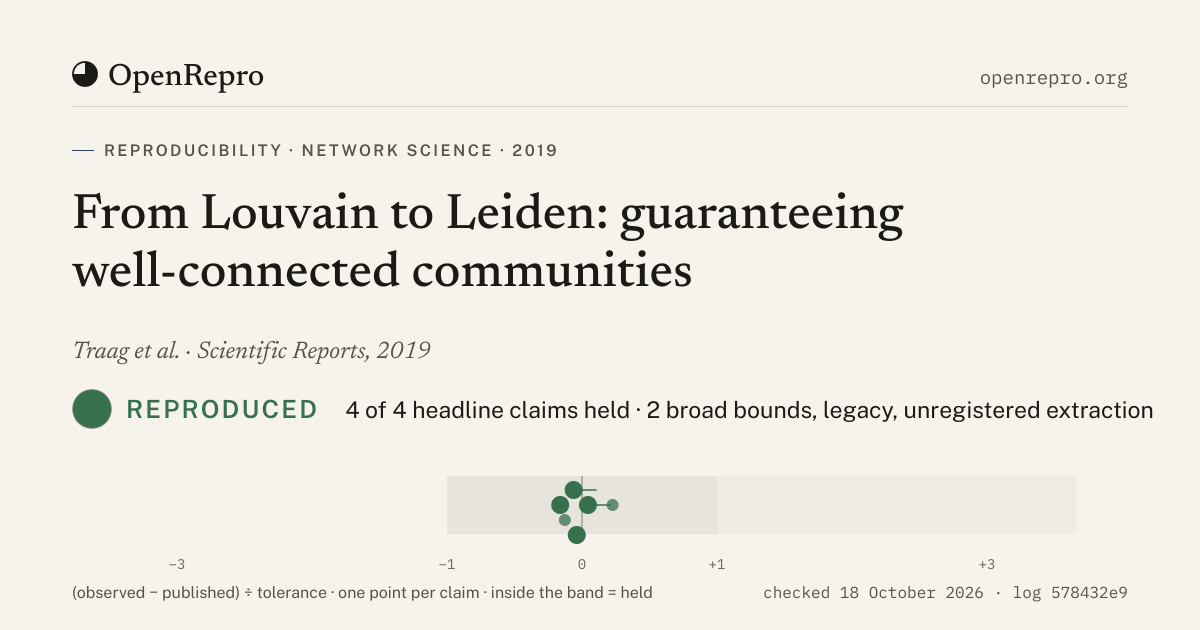
Does From Louvain to Leiden (Traag et al., 2019) reproduce? Yes, on its headline claims: when OpenRepro re-ran the authors' code, 4 of 4 headline claims held within tolerances registered before results were recorded; DBLP Leiden gain over Louvain 0.938× the published value; passes a registered floor of 0, a sign check; Amazon Leiden gain over Louvain 1.04× the published value; passes a registered floor of 0, a sign check; legacy attempt: the plan was never sealed; claims were frozen only by their first result; at least one value was read from an excerpt the agent chose after seeing the output, not by a rule fixed before it (checked 18 Oct 2026).
Does “From Louvain to Leiden” reproduce?
Yes, on its headline claims. 4 of 4 headline claims held within tolerances registered before results were recorded; DBLP Leiden gain over Louvain 0.938× the published value; passes a registered floor of 0, a sign check; Amazon Leiden gain over Louvain 1.04× the published value; passes a registered floor of 0, a sign check; legacy attempt: the plan was never sealed; claims were frozen only by their first result; at least one value was read from an excerpt the agent chose after seeing the output, not by a rule fixed before it.
- Held (large: headline claim; small: other claim)
Reading the marks
- Tail: a one-sided claim (at most, at least); the tail points to the open side, which is shaded faintly
The data behind this chart
| Claim | Published | Observed | Accepted if | Deviation ÷ tolerance | Result |
|---|---|---|---|---|---|
| On DBLP, the maximal modularity found by the Leiden algorithm over 10 replications of 10 iterations is 0.8387. (headline) | 0.8387 | 0.838377 | within ±0.002 | -0.16 | Held |
| On Amazon, the maximal modularity found by the Leiden algorithm is 0.9341. (headline) | 0.9341 | 0.934022 | within ±0.002 | -0.04 | Held |
| On DBLP, the maximal modularity found by the Louvain algorithm is 0.8262. | 0.8262 | 0.826653 | within ±0.002 | +0.23 | Held |
| On Amazon, the maximal modularity found by the Louvain algorithm is 0.9301. | 0.9301 | 0.929846 | within ±0.002 | -0.13 | Held |
| On DBLP, Leiden finds higher maximal modularity than Louvain (paper: +0.0125). (headline) | 0.0125 | 0.011724 | at least 0 | -0.06 | Held |
| On Amazon, Leiden finds higher maximal modularity than Louvain (paper: +0.0040). (headline) | 0.004 | 0.004176 | at least 0 | +0.04 | Held |
What the attempt found
Using the authors Java implementation at the release tag matching the paper (networkanalysis 1.0.0) on the SNAP DBLP and Amazon networks, with the paper protocol of 10 random starts of 10 iterations each, all tested Table II values reproduced within 0.0005: DBLP Louvain 0.8267 vs 0.8262 and Leiden 0.8384 vs 0.8387; Amazon Louvain 0.9298 vs 0.9301 and Leiden 0.9340 vs 0.9341. Leiden found higher modularity than Louvain on both networks, as claimed. The other four networks in Table II were out of scope (download blocked, proprietary, or too large for the sandbox), and the badly connected community percentages in Fig. 4 were not tested.
Assurance
- Level
- Legacy (what the levels mean)
- Plan
- Not sealed (legacy): claims were registered before results were recorded, which does not show that no output had been seen
- Evidence
- Legacy matching: each observed value was matched against the text of the logged output it cites
- Execution manifest
- No: not recorded for every cited run, or incomplete (no Git checkout, a driver file that could not be hashed)
- Report re-derived from the log
- Passed: the engine re-derived the report from the log
- Engine version
- 0.2.1
- Predates
- plan seal, evidence binding, execution manifest, paper text hash, scored job flag, retry reasons, extraction rule
- Qualifiers
- DBLP Leiden gain over Louvain 0.938× the published value; passes a registered floor of 0, a sign check; Amazon Leiden gain over Louvain 1.04× the published value; passes a registered floor of 0, a sign check; legacy attempt: the plan was never sealed; claims were frozen only by their first result; at least one value was read from an excerpt the agent chose after seeing the output, not by a rule fixed before it
Headline claims
| Claim | Published | Observed | Accepted if | Result |
|---|---|---|---|---|
| On DBLP, the maximal modularity found by the Leiden algorithm over 10 replications of 10 iterations is 0.8387.¶Table II, p. 6 (text p. 9) · registered at event 10 · quote verified on p. 9 · equivalence check | 0.8387modularity | 0.838377 | within ±0.002 | Held |
| On Amazon, the maximal modularity found by the Leiden algorithm is 0.9341.¶Table II, p. 6 (text p. 9) · registered at event 11 · quote verified on p. 9 · equivalence check | 0.9341modularity | 0.934022 | within ±0.002 | Held |
| On DBLP, Leiden finds higher maximal modularity than Louvain (paper: +0.0125).¶Table II, p. 6 (text p. 9) · registered at event 14 · quote verified on p. 9 · broad bound, observed 0.938× the published value | 0.0125modularity | 0.011724 | at least 0 | Held |
| On Amazon, Leiden finds higher maximal modularity than Louvain (paper: +0.0040).¶Table II, p. 6 (text p. 9) · registered at event 15 · quote verified on p. 9 · broad bound, observed 1.04× the published value | 0.004modularity | 0.004176 | at least 0 | Held |
Other claims checked
| Claim | Published | Observed | Accepted if | Result |
|---|---|---|---|---|
| On DBLP, the maximal modularity found by the Louvain algorithm is 0.8262.¶Table II, p. 6 (text p. 9) · registered at event 12 · quote verified on p. 9 · equivalence check | 0.8262modularity | 0.826653 | within ±0.002 | Held |
| On Amazon, the maximal modularity found by the Louvain algorithm is 0.9301.¶Table II, p. 6 (text p. 9) · registered at event 13 · quote verified on p. 9 · equivalence check | 0.9301modularity | 0.929846 | within ±0.002 | Held |
Deviations from the paper's setup
- noneBuilt and run with OpenJDK 21 instead of a 2018-era JDK.
- minorSNAP node ids were renumbered to 0..n-1 in sorted order, and runs used a fixed seed (20261018) rather than an unspecified random one.
The run
- Wall time
- 9 min, 18 October 2026 to 18 October 2026
- Job compute
- 2 min 51 s across 1 job
- Code the results name
- CWTSLeiden/networkanalysis at 2d38563
- Work tree at the end
- CWTSLeiden/networkanalysis at 2d38563
- Container image
- repro-sandbox:0.2 sha256:134b91122c63…
- Sandbox
- 3.5 CPUs, 6 GB, no GPU
- Run by
- Claude (claude-opus-5-5), an AI agent made by Anthropic, in a Claude Code session
- Attempt
- arxiv-1810-08473-20261018T013946Z
- Log
- 42 events, head 578432e9
Evidence
The full evidence report has the exact paper quotes, the method behind every number, the reason for each tolerance, notes made during the attempt and the environment it ran in. The raw report.json is the unmodified data this page is built from.
Log seal · 42 hash-chained events
578432e9062b72e8e2576db5eeed0bf5ac96e6f5b649204a2e77964f446edc6c
How to cite this report
OpenRepro (2026). Reproducibility report: From Louvain to Leiden: guaranteeing well-connected communities. Reproduced; 4 of 4 headline claims held (DBLP Leiden gain over Louvain 0.938× the published value; passes a registered floor of 0, a sign check; Amazon Leiden gain over Louvain 1.04× the published value; passes a registered floor of 0, a sign check; legacy attempt: the plan was never sealed; claims were frozen only by their first result; at least one value was read from an excerpt the agent chose after seeing the output, not by a rule fixed before it). Attempt arxiv-1810-08473-20261018T013946Z, log head 578432e9062b72e8, checked 18 Oct 2026. https://openrepro.org/papers/1810.08473/
BibTeX
@techreport{openrepro-1810.08473,
  author      = {{OpenRepro}},
  title       = {Reproducibility report: From Louvain to Leiden: guaranteeing well-connected communities},
  institution = {OpenRepro},
  year        = {2026},
  url         = {https://openrepro.org/papers/1810.08473/},
  note        = {Attempt arxiv-1810-08473-20261018T013946Z; log head 578432e9062b72e8; checked 18 Oct 2026}
}
Badge

Authors and maintainers may embed this badge; it always reflects the current report, and a correction updates it.
[](https://openrepro.org/papers/1810.08473/)<a href="https://openrepro.org/papers/1810.08473/"><img src="https://openrepro.org/badge/1810.08473.svg" alt="OpenRepro: Reproduced. 4 of 4 headline claims held; DBLP Leiden gain over Louvain 0.938× the published value; passes a registered floor of 0, a sign check; Amazon Leiden gain over Louvain 1.04× the published value; passes a registered floor of 0, a sign check; legacy attempt: the plan was never sealed; claims were frozen only by their first result; at least one value was read from an excerpt the agent chose after seeing the output, not by a rule fixed before it." width="513" height="20"></a>Right of reply, and reporting an error
Authors may submit a response, which is published alongside this report unedited. Write to hello@openrepro.org.
Anyone, not only an author, can report an error in an attempt to the same address. The same address takes suggestions of papers to check and questions about the method.